
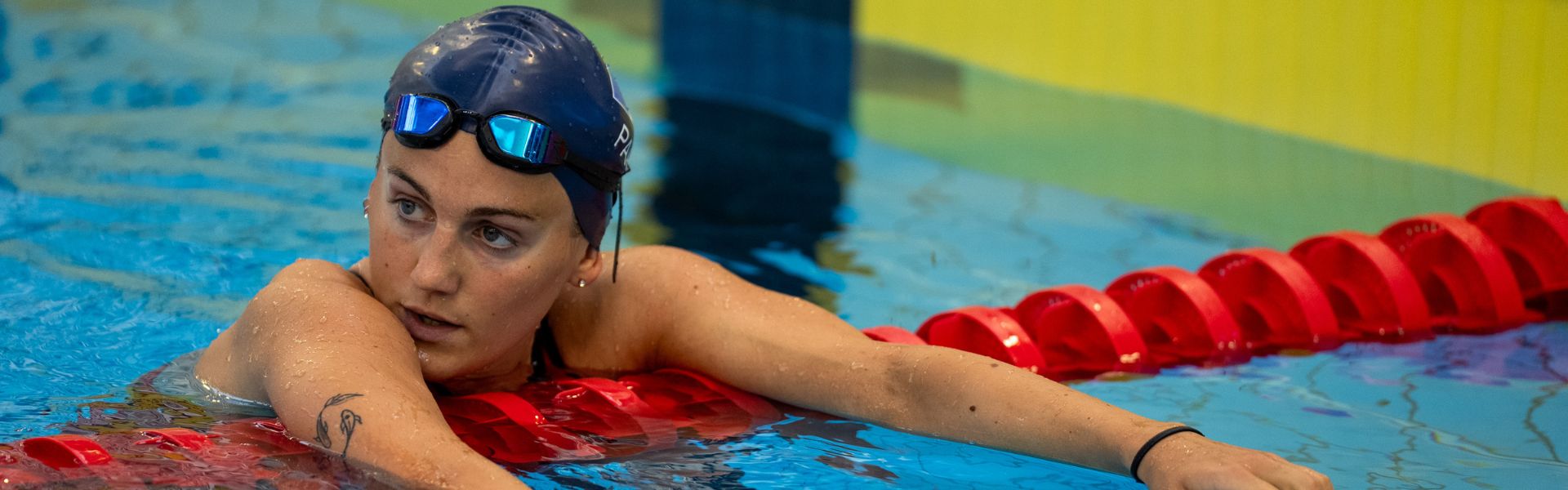
Since 2025, Nexans has chosen to support the progress and development of French Paralympic athlete Agathe Pauli. A high-level swimmer, ambitious and determined, we met her at the start of the year to get to know her better. Earplugs, competitions, and cable testing—dive into Agathe’s world.
Who are you, Agathe Pauli?
I’m 22, I’m from Marseille, and I was born with a right femoral agenesis. In simple terms, I don’t have a femur in my right leg. And I swim. I’m a high-level athlete and I’ve been competing since I was 7. I took part in my first Paralympic Games in Paris in 2024, and now I’m aiming for a podium in Los Angeles in 2028.
What’s your first memory related to swimming?
I must have been about 5. My older sister, who’s two years older than me, and I were signed up for swimming lessons to learn how to swim. What I remember most is how huge the pools felt. They seemed enormous, even though they probably weren’t more than three by four meters. I also remember the very distinctive smell—a mix of bleach and chlorine. It really stuck with me.
Did you enjoy it right away?
At first, it was just about learning to swim, almost like a necessary step. I didn’t fall in love with it immediately. But I had some natural ability, which allowed me to join my sister’s group.
It was when I started competing that I really had a breakthrough. I discovered a new kind of enjoyment: the adrenaline of races, the satisfaction of improving, the pride of winning trophies. That competitive, demanding, and stimulating aspect made me want to keep going.
The high-performance turning point
Was there someone who played a key role in your journey?
Yes, clearly my first coach at Handisport Marseille, Sophie Casgha. We laughed a lot, there was a great team atmosphere. Even when training was tough, we still laughed, and it made the two-hour round trip to get to the pool worth it.
When did you realize swimming could become a high-level project?
At my first international competition, the European Youth Championships. I was 15. It was the first time I swam against foreign athletes. In France, the level of competition is quite limited, but internationally, you really see where you stand. It made me realize I needed to work much harder.
And then what happened?
Right after that, I left home and moved to Bordeaux to join a national training center. Training became much more intense—it was no longer just three times a week. The high-performance project became real, and above all, I saw progress in the pool.
“If I change classification, I can aim for gold in Los Angeles.”
How would you describe your progression from the beginning until now?
The progress has been huge. There’s a world of difference between my first competition and the Paralympic Games. I’ve competed in World and European Championships. But most of all, I’ve improved mentally—how I approach races. Experience, over time, changes everything.
What are your strengths in the water today?
I have a very good glide and strong arm work. Since I only have one leg, I’ve learned to compensate and adapt technically.
Classification, what is it?
In Paralympic swimming, athletes are classified into categories that determine their competition group. For physical impairments, they range from S1 (very limited mobility) to S10 (almost full mobility). Categories S11 to S13 are for visually impaired athletes, S14 for athletes with intellectual disabilities, and S15 for athletes with hearing impairments.
Classification is an important issue in your sport. How do you experience it?
Right now, I’m classified S9, but I’m trying to have that reviewed. At this level, I’m competing against athletes with much greater mobility than mine, especially in the lower body. Classification isn’t entirely scientific—there can be big differences between athletes in the same category. I also have scoliosis in addition to my femoral agenesis, which affects my balance in the water. If I move to S8, I could clearly aim for gold in Los Angeles.
Mental strength and handling pressure
What areas are you currently working on the most to support your progress?
There are two main areas: technique and mental preparation. Technically, I work a lot on breathing—knowing when to breathe, during which movement. It requires a lot of focus and repetition. Mentally, I’ve been working with a specialist for a year and a half. She’s not from the sports world, so we can talk about many things—it’s very helpful.
What does this work bring you?
It mainly helps me put things into perspective. We do a lot of visualization, learning to zoom out and create distance from situations. The goal is to keep useful stress without being overwhelmed by it. Sometimes I don’t even set a time goal—I focus on race strategy.
Paris 2024, a unique moment
Which competition has marked you the most so far?
Without hesitation, the Paris Paralympic Games. It was incredible. When you reach a final with 15,000 people in the stands, it’s nothing like a World Championship with 200 spectators. During the relay, it was so loud I had to cover my ears.
What memories do you keep from the Games?
Arriving at the village—it felt unreal. Like being in a movie. All the countries, all the disabilities—it’s a world within a world. I even requested an electric wheelchair to avoid excessive fatigue. And then there was the celebration afterward.
A clear path toward the 2028 Games
What are your goals for the 2026 season?
For now, the European Championships are the main goal—if they take place (they’re still not confirmed for 2026). But everything depends on my reclassification, which I’ll go through either in March in Barcelona or in May in Paris. In S8, I could aim for several podiums.
But if I had to set one goal, it would be to reach a podium, regardless of classification. And I’d like to improve my time of 4:49 in the 400m freestyle.
Have you changed your routine to achieve this?
I swim much more: from 35–40 km per week to around 50 km. I also have a training camp in Australia coming up, and I’m really looking forward to training alongside swimmers like Lakeisha Patterson.
Looking further ahead to the Los Angeles Games?
Aim for podiums and keep performing. But again, classification can change everything. Right now, it’s hard to accept competing against athletes I can’t realistically beat. I hate injustice, and it’s sometimes difficult when not everything depends on you.
“Thanks to Nexans, I always feel supported”
Nexans has been supporting you since 2025—what does this partnership bring you?
A lot of support. I’ve already met employees, visited sites, and I often receive messages of encouragement. Feeling supported makes a huge difference. I don’t feel alone in my project, which can sometimes happen.
Nexans strongly promotes teamwork and unity—how do you experience that in such an individual sport?
Teamwork is essential. Behind me, there’s my coach, strength trainer, physiotherapists, mental coach, the French team staff, and sponsors. I swim, and they all work to help me succeed. You have to learn to trust them and delegate.
I have another example. Nexans is a multinational, present across many continents and countries, yet you all work toward a common goal. In swimming, relays remind me of that. We all train individually in our own cities, but on the day, together, we perform to achieve a shared objective.
You visited our AmpaCity innovation center in Lyon—what impressed you the most?
I was impressed by the level of technical expertise required to design and manufacture a cable: the specifications, all the testing. I realized how essential cables are to our daily lives. I especially enjoyed the exchanges with employees—the Q&A sessions. People were very attentive, and it was really pleasant.
To conclude, what mindset are you in at the start of this year?
After the Games, there’s always a risk of a drop—less excitement, less attention. But athletes keep training just as hard. The support of partners like Nexans allows me to feel more at ease, to plan ahead, to organize training camps without being held back. It’s essential. It means I can keep moving forward and aim for the best.