






Sustainable buildings for a brighter future
Electrification of tomorrow
12/10/2023
Hospitals, data centers, airports and mission-critical facilities demand the highest standards of safety, reliability and sustainability. Their electrical load profile is changing at unprecedented speed: distributed solar, storage, EV charging, higher rack densities and digitalized building systems are turning the last kilometer of the grid into a mission-critical asset.
Nexans engineers the cabling solutions that keep them running.

of global final energy consumed in buildings sector (IEA 2025)
of building devices run natively on direct current
electricity demand from buildings by 2050 (IEA)
Critical buildings, hospitals, airports, data centers, transport hubs, campuses and government facilities, represent the connective tissue of the global economy. They operate 24/7, tolerating zero downtime, yet face mounting pressure to decarbonize, electrify, and integrate renewable energy at speed.
Buildings already account for ~30% of global final energy consumption and more than half of all electricity demand worldwide (IEA 2025). With global floor area set to double by 2060, and the proliferation of EV charging, battery storage, solar and IoT devices, the density of electrical infrastructure inside buildings is accelerating sharply.
The DC microgrid market alone is projected to surpass $51 billion by 2035 at a 19.5% CAGR, driven by the native compatibility of PV, EVs and batteries with direct current. Meanwhile, fire safety regulations are tightening worldwide, and ESG mandates are elevating expectations for every material in the building’s envelope, including cables.
This convergence creates a once-in-a-generation opportunity for solutions providers who can cover the full project lifecycle: design, specification, installation, commissioning, and circular end-of-life management.
global data center construction market size in 2024 (Grand View Research 2025)
CAGR of global DC microgrid market 2025-2034 (GM Insights / Research Nester 2025)
structured cabling market in 2025, rising to $20.7b by 2035 (Global Growth Insights 2026)
Zero-downtime power continuity
Hospitals, airports, financial infrastructure and data centers cannot tolerate interruption. Cabling systems must guarantee circuit integrity even under catastrophic fire conditions, but they must also support commissioning schedules, grid-connection constraints and high-density power demand. In data centers, even a delayed cable delivery can jeopardize the commissioning schedule; critical electrical equipment lead times now reach 18 to 36 months in some markets.
Net zero & decarbonization mandates
Buildings must reduce CO₂ emissions by more than 95% by 2050 under IEA Net Zero scenarios. Every component, from the cable insulation to the installation process, must now carry verifiable environmental credentials and support a circular economy model. Specifiers are moving from generic sustainability claims to product-level evidence: PEP Ecopassport declarations, life-cycle assessment data, recycled-metal content and supplier decarbonization.
Fire safety compliance
A fire breaks out in a European building every 30 seconds, with 25%+ caused by electrical faults (FEEDS). Tightening regulations, including the French 2025 requirements for tertiary and high-rise buildings, and Construction Products Regulations (CPR) in Europe, require cables that actively limit flame spread, smoke, and toxic emissions in public spaces. Nexans Protect goes beyond baseline compliance with low-smoke, halogen-free cables manufactured primarily in France and performance that reduces fire spread by a factor of 5 to 10 compared with conventional U1000 R2V cables.
Integrating renewable energy & storage
Over 70% of building devices natively operate on DC power. Solar PV, BESS and EV chargers, all DC, are now standard on critical building projects. Traditional AC-only infrastructure creates conversion losses, cost and complexity that DC microgrids directly eliminate.
Installation speed & safety
Labor shortages, compressed construction timelines and hyperscale commissioning windows make faster, safer cable laying is a competitive differentiator. On complex tertiary and data center projects, cable drum handling can create musculoskeletal risk, on-site accidents, and planning delays.
Standardization & interoperability
DC microgrid ecosystems are still maturing. Without established cross-manufacturer standards, installers face compatibility risks, warranty voids and specification uncertainty. Active participation in standardization bodies is now a prerequisite for credible DC solution providers.
Nexans brings more than 120 years of electrification expertise to critical building projects. Our portfolio spans every layer of the electrical system, from the primary power feed to the last-meter DC connection, backed by industry-leading R&D, global manufacturing, and a growing suite of beyond-cable services.
We work alongside owners, engineers, architects, contractors and system integrators from specification through commissioning, and support the circular end-of-life of every cable we supply.
CableLoop Recycling Service
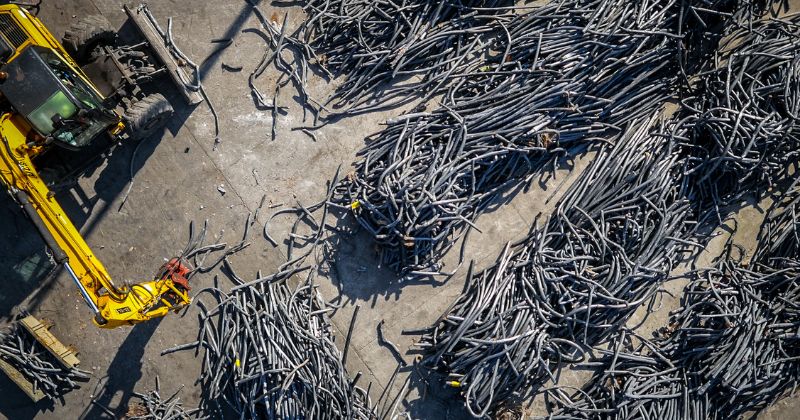
Close the loop on electrical infrastructure. CableLoop collects and recycles end-of-life copper and aluminum cables from job sites and facilities, recovering 30,000+ tonnes annually and feeding recovered metals back into Nexans’ low-carbon cable production.
MOBIWAY™ Range
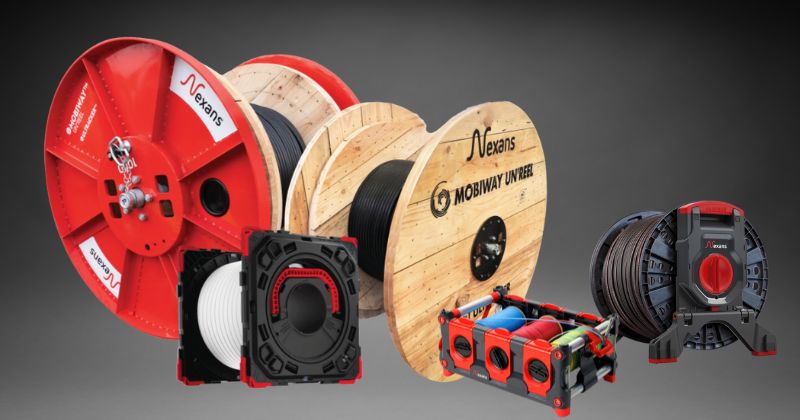
Purpose-engineered cable handling and unwinding systems that help installers save up to 30% of installation time on average, reduce physical strain and improve jobsite safety. Designed around real construction-site conditions, the MOBIWAY™ range supports faster, safer cable installation across residential, commercial, tertiary and large critical-building projects.
DC microgrids eliminate the conversion losses of AC-to-DC conversion, delivering 20–30% less energy loss and up to 10–20% lower CO₂ footprint compared to conventional architectures. Nexans is developing a dedicated portfolio of Low Voltage DC (LVDC) cables, designed to comply with CurrentOS specification rules and compatible with all safety zones in a DC building, from the PV rooftop to the server room. As one of 63+ partners co-developing global DC standards, Nexans is at the forefront of a market set to reach $8.7 billion in 2025 and $51+ billion by 2035.
≈ 20–30%
less energy loss vs AC.
≈ 30%
more power for same copper.
≈ 70%
of devices are natively DC.
Tomorrow’s buildings will be smart, connected and sustainable with a DC power supply. Reflecting its active commitment to this transformation, Nexans is manufacturing specific cable systems compatible with these new infrastructures.

Head of the LVDC and MVDC technical platforms and new architectures at the Research and Regions Tech Centre, Nexans
Nexans contributes to the standards, conversations and technical ecosystems that will define critical building infrastructure for decades.
Article
Serie : Innovations for Buildings’ Revolution

Electrification of tomorrow
12/10/2023
Article
Serie : Innovations for Buildings’ Revolution

Electrification of tomorrow
25/07/2023
Article
Serie : Innovations for Buildings’ Revolution

Electrification of tomorrow
18/07/2023
Article
Serie : Innovations for Buildings’ Revolution

Electrification of tomorrow
04/07/2023
Article
Serie : Innovations for Buildings’ Revolution

Electrification of tomorrow
27/06/2023
Article
Serie : 10 Technologies to Electrify the Future

Electrification of tomorrow
14/06/2022
Low-carbon manufacturing
Our Low-Carbon Program targets verified reduction of Scope 1, 2 and 3 emissions across the cable manufacturing process, with certified environmental declarations on every product via PEP Ecopassport®.
CableLoop: Circular Economy
30,000 tonnes of cables processed annually. 18,000 tonnes of copper and aluminum granules recovered. Target: 25% recycled copper in all Nexans cables by 2028. End-of-life is not the end of the story.
DC Efficiency Gains
By enabling DC microgrids with purpose-designed LVDC cables, Nexans helps buildings achieve 20–30% lower energy losses and a 10–20% reduction in CO₂ footprint compared to traditional AC distribution architectures.

Our team of experts is ready to support you from specification through commissioning, with solutions that deliver safety, sustainability and performance from day one.