The real cost of a data center delay: how EPCs and contractors can protect their margins when the supply chain breaks

90% of data center projects are delayed by an average of 34%. The penalty: 0.25% of total project cost per week. Cable ends installation alone can take 3 months on a mid-size project. The question is not whether your supply chain will be tested. It is whether your cable partner will hold.

data center

Key figures

90%

of data center projects are delayed, by 34% on average

0.25%

of total project cost per week, a typical delay penalty in data center contracts

3 months

to install cable terminations on a mid-size data center project

The cost of delay

The delay economy: what the numbers actually mean for your project

Delays in data center construction are not the exception. They are the statistical norm. In a sector where build cycles run 12 to 18 months and rack densities are moving from 10 kW to 200 kW per rack, the margin for error in the supply chain is measured in days, not weeks.

The financial exposure is concrete. At 0.25% of total project cost per week, a mid-size data center running four weeks behind schedule triggers a penalty exposure that can erase an entire margin tranche before a single server goes live. The NSA data center case documented over $500,000 in costs attributable directly to electrical malfunctions and installation failures. These are not outliers. They are what happens when cable specification decisions made upstream do not survive contact with the construction site.

The cable’s role in the critical path is consistently underestimated. It is not a commodity item that can be swapped at short notice. Medium voltage cables carry lead times. They carry certification requirements tied to the specific regulatory context of the country of installation. They carry pulling force calculations and bending radius constraints that are not interchangeable between product families. When a cable specified in one normative environment is ordered for installation in another, the consequences do not surface at procurement. They surface on site, at the point where installation is impossible and the clock is running.

Installation

The installation bottleneck: where three months disappear

80% of general contractors report difficulty filling skilled electrical positions. On a data center project managing 50 to 80 cable references across high-density environments with 100 to 200 kW per rack and liquid cooling integration, that labor constraint is not a background risk. It is a daily operational constraint.

Cable terminations installation alone can consume three months on a mid-size project. The density of coordination required, between low-voltage control wiring, MV power distribution, and cooling integration pathways, creates a sequencing problem that no amount of schedule compression resolves unless the cable itself is designed to be installed fast.

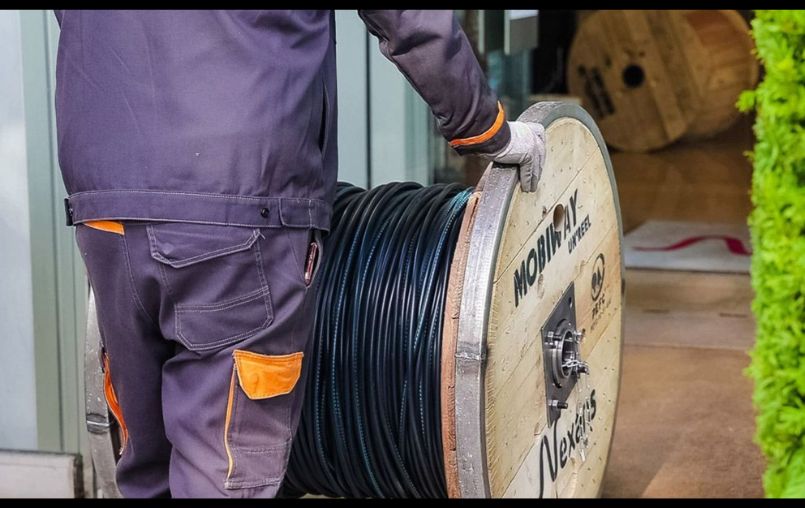
Mobiway UNโ€™REEL

Nexans addresses this at the product and packaging level. Mobiway Un’reel is a patented smart packaging system that simplifies unwinding and reduces on-site handling time, directly cutting labor hours per pull. Customized cable lengths, including pre-cut and reel-optimized configurations, eliminate the measurement and cutting steps that slow installation teams on dense projects. Optimized bending radius specifications reduce the physical constraints in tight thermal and space envelopes. The combined effect is a 5x improvement in installation efficiency compared to standard cable handling methods.

These are not incremental gains. On a project where cable installation is on the critical path and every week of delay triggers a financial penalty, they are margin protection.

80%

of general contractors struggle to hire skilled electricians

50-80

cable references on a typical data center project

Up to 5x

installation efficiency with Mobiway range

Supply chain

Supply chain as a competitive weapon: real-time visibility, prioritized capacity

A cable order confirmed six months before project start means nothing if the drums are not on site when the installation crew is ready. Real-time supply chain visibility is not a reporting feature. It is a project management tool.

Ultracker is Nexans’ cable drum fleet tracking system. It provides real-time location data for every drum in transit, with loss and theft prevention built in. For a project manager coordinating parallel installation teams across a data center campus, knowing exactly when material arrives is not a convenience. It is the difference between a crew that works and a crew that waits.

Beyond tracking, Nexans offers prioritized plant capacity allocation for strategic projects, with up to two weeks of improved lead time versus standard market availability. A dedicated contact person is assigned to each project, providing a single accountable point of coordination from order to commissioning. The Nexans portfolio covers 90% or more of a typical data center bill of materials, reducing the vendor complexity that creates scheduling fragmentation when multiple suppliers operate on different delivery timelines.

In a market where transformer lead times run two to five years and switchgear lead times reach 18 to 36 months, cable supply chain reliability is one of the few variables a project team can actively control. With the right partner, it becomes a competitive advantage.

Compliance

The compliance cost of getting it wrong: 12 standards, 50 to 80 references, one project

A data center project in France involves navigating a minimum of 12 applicable cable standards, including CPR classification, IEC performance standards, NF local norms, and LSZH fire safety requirements for enclosed environments. A single cable reference that does not comply with the applicable standard for its installation context does not generate a site note. It generates a rejection, a replacement order, a recalculation of pulling forces, and a delay that compounds against every downstream installation sequence.

The MV cable scenario is instructive. A data center operator in France specified MV cables based on a recommendation from a British engineering firm. The specification was technically sound in a UK normative context. It was not adapted to French installation conditions, where underground ducting geometry, local grid interface standards, and civil works contractor practices differ materially from UK equivalents. The cables arrived on site. The installation team could not pull them. The operator contacted Nexans for an emergency technical assessment, pulling force calculations, and a replacement product validation. The Nexans team delivered the analysis and secured the alternative specification. The project continued.

This scenario is not rare. It is what happens when multi-jurisdiction projects are managed without a cable partner who holds a global portfolio and local normative expertise simultaneously. Nexans’ multi-standard capability, covering CPR, IEC, NEC, and national derivatives across 50 countries, is not a product feature. It is a project risk elimination tool.


ESG

ESG as a new tender criterion: what hyperscalers now require from their EPC partners

The tender landscape for data center EPC contracts has changed. AWS, Microsoft, Google, and Meta now embed Scope 3 and carbon performance requirements in their EPC contracts. A contractor who cannot provide certified environmental data for the cables they install is no longer compliant with the procurement requirements of the largest data center operators in the market.

Nexans’ response is built on three pillars. First, PEP Ecopassport certification covers 98% of the certified product range, providing verified CO2e/kg figures for every cable reference that can be submitted directly to a hyperscaler’s Scope 3 Category 1 reporting system. Second, low-carbon cables in the Nexans portfolio deliver a minimum 35% reduction in CO2 emissions compared to standard references, certified by Bureau Veritas, with 100% low-carbon aluminum and up to 50% recycled plastic in eligible product families. Third, CableLoop provides end-of-life cable collection, BSD documentation, and certified material recovery, closing the loop on cable waste and providing the traceability documentation that LEED and CSRD disclosures require.

For an EPC competing on a hyperscaler data center contract, this is no longer a sustainability differentiator. It is a baseline compliance requirement. The contractors who win these bids are the ones whose supply chain can document its carbon footprint, not just its delivery schedule.

98%

of the Nexans product range covered by PEP ecopassport data for Scope 3 reporting

-35%

minimum COโ‚‚ reduction with Nexans low-carbon cables, certified by Bureau Veritas

CableLoop

cable collection, waste tracking documentation and certified material recovery

Technical support

What Nexans delivers when the project is already in trouble

The most valuable moment for a cable partner is not at tender stage. It is at 11pm on a Tuesday when an installation crew cannot pull the specified cable and the commissioning date is six weeks away.

Nexans’ technical teams provide pulling force calculations, normative compliance assessments, and replacement product validation for in-progress projects where a specification issue has been identified. The dedicated contact person model means there is always a named expert reachable, not a call center, not a ticketing system. When a contractor contacts Nexans with an urgent technical request, the response is a technical file, not a commercial proposal.

This operational capability is backed by a global portfolio that covers the full data center cable scope: MV distribution cables with TR XLPE insulation for optimized energy efficiency, 133% insulation level cables reducing electrical stress and extending service life, LSZH cables meeting Construction Products Regulation and IEC 60332-3-24 bundled cable requirements. One partner. One bill of materials. One point of accountability.

Nexans Data Center Power

Back to Nexans Data Center Power