





Power cables and accessories for data centers

Power cables and their accessories carry every watt from the grid to the servers. Their selection, compatibility and installation quality determine a large part of a data center’s electrical reliability. Nexans has brought its expertise together in two white papers: one on selecting power cables, one on securing cable accessories and their installation.

data center
WHITE PAPERS

Two white papers to secure your data center’s power infrastructure

data center cables

Why power cables are strategic assets for data centers

Key considerations for reliability, energy and scalability ยท PDF, 16 pages Why cables, at 2 to 2.5% of construction costs, weigh so heavily on uptime, the six criteria to select them, and solutions from fire safety and low-carbon cables to HTS superconductors.

Nexans Easy Tech joints video extract

How to de-risk data center power connections

Accessories installation best practices for long-term reliability ยท PDF, 14 pages Why 75% of medium-voltage grid failures happen at joints, how training and certification prevent installation errors, and accessories from 6 kV to 145 kV.

Key figures

85%

of equipment failures in medium-voltage grids occur in cable systems (Source: Mehairjan et al., Stedin; Enedis network data)

75%

of medium-voltage grid failures occur at cable joints (Source: Mehairjan et al., Stedin; Enedis network data)

60%

of premature joint breakdowns are caused by faulty installation (Source: Higinbotham et al., EA Technology)

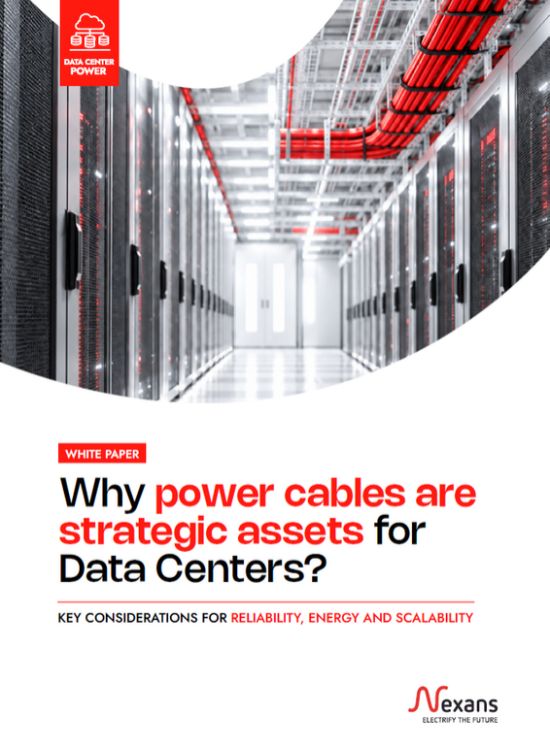
White paper cover for Why power cables are strategic assets for data centers?
POWER CABLES

Data center power cables: ensuring business continuity as power demand grows

Power cables account for only 2 to 2.5% of a data center’s construction costs, yet they carry every watt to critical IT and cooling equipment. Their selection directly affects uptime, fire safety, energy losses and the ability to scale.

Six criteria guide the choice. The voltage rating must match each part of the power chain, from high voltage at the grid connection to low voltage inside the data halls. Fire performance limits fire spread and smoke, and keeps safety systems running during a fire. Low-resistance conductors reduce energy losses. Cables must withstand high temperatures in densely packed environments, last for the life of the facility and be made with lower-impact materials.

For hyperscale campuses, high-temperature superconducting cables add another option: a single HTS cable can transmit up to 3.2 GW with near-zero losses, in a much narrower footprint.
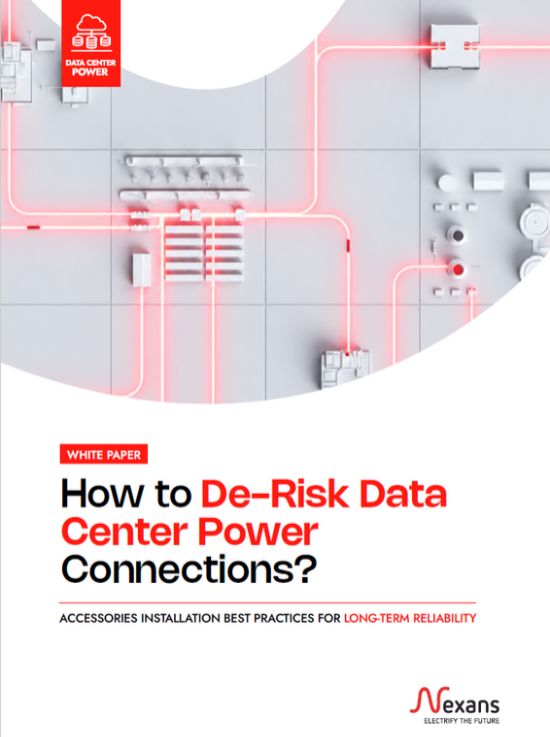

White paper cover for How to de-risk data center power connections?
ELECTRICAL ACCESSORIES

Cable joints and terminations: securing connections and reducing the risk of failure

Even with high-performance cables, a data center’s power network is only as reliable as its connections. Joints and terminations link network components and maintain power continuity, and most medium-voltage failures occur at these points.

Faulty installation is the leading cause of premature accessory failures. Controlled installation practices therefore matter as much as the accessories themselves. Nexans certifies more than 1,500 installers every year through training centres in 11 countries, with a 95% success rate in 2023, and provides on-site installation supervision for large projects.

Preassembled solutions such as jumpers and junction boxes reduce on-site work and the risk of error, across a range covering 6 kV to 145 kV and designed for more than 50 years of service life.

How can electrical risks in data centers be reduced?

Reducing electrical risk in a data center takes a lifecycle approach: match cables and accessories to the project, control installation quality, monitor the network and design for future growth. Most failures can be traced back to a gap in one of these steps.

  1. Match equipment to project requirements
    Cables and accessories must meet the project’s voltage levels, thermal constraints, installation conditions and power demand.
  2. Prioritize appropriate safety performance
    Cable and accessory characteristics should limit electrical and fire risks while meeting the requirements of each project.
  3. Ensure high installation quality
    Following installation procedures, using the right tools and training installation teams reduce errors and premature failures.
  4. Monitor the power network
    Electrical monitoring and data analysis detect early warning signs of failure and help plan maintenance before service is interrupted.
  5. Design for scalability
    Equipment sizing and distribution layouts should anticipate future increases in power demand and data center expansion.
red geometrical forms on grey background
INSIGHTS

Go further with our two white papers

Power cables and cable accessories: expert guidance to secure your data center’s power supply.

Choose your white paper
FAQ

Power cables and accessories for data centers: FAQ

CONTACT

Let’s talk about your project

Discuss your cable and accessory specifications with our data center experts, from design to installation.

Nexans Data Center Power

Back to Nexans Data Center Power