



1 GW
target per link
Partnership
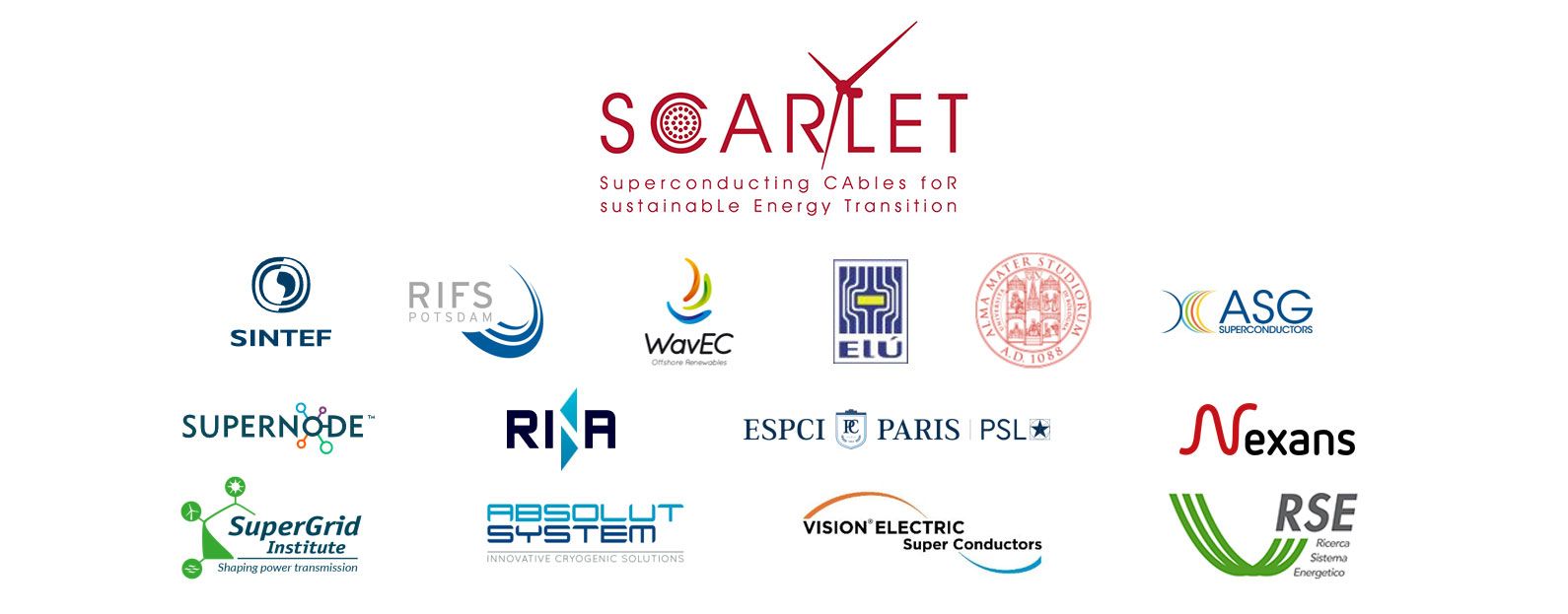
15 consortium partners
Market
Superconductivity
Location
Europe
Nexans joined a 15-partner European consortium to bring High-Temperature Superconducting cable systems to industrial scale, enabling gigawatt transmission with near-zero losses.
Bridging demonstration and industrial readiness for superconducting grids
Europe’s energy transition demands a fundamental rethink of how electricity is moved across the continent. As renewable generation grows and power flows become more complex, conventional cables are reaching their physical and economic limits.
Funded under the European Union’s Horizon Europe programme, SCARLET (“Superconducting Cables for Sustainable Energy Transition”) is a flagship research and industrialisation initiative. It brings together 15 partners across 7 countries with a shared ambition: to design, manufacture, and validate superconducting cable systems at the gigawatt scale, ready for commercial deployment.
The project targets a paradigm shift in power transmission, moving from High-Voltage Direct Current (HVDC) at very high voltage to Medium-Voltage Direct Current (MVDC) superconducting cables that can carry equivalent power levels in a far smaller physical footprint. A single 17 cm-diameter HTS cable can transmit up to 3.2 GW, a feat that conventional cables cannot match in constrained corridors.
SCARLET addresses the full system lifecycle, from conductor manufacturing and cryogenic engineering to type testing, system protection, and techno-economic assessment. By the project’s conclusion, both onshore and offshore HTS cable systems will have reached the final qualification step before commercial installation.
The initiative also responds to a critical strategic need: as offshore wind capacity accelerates and urban grids face saturation, superconducting cables offer a technologically and economically viable path that conventional HVDC solutions cannot always provide.
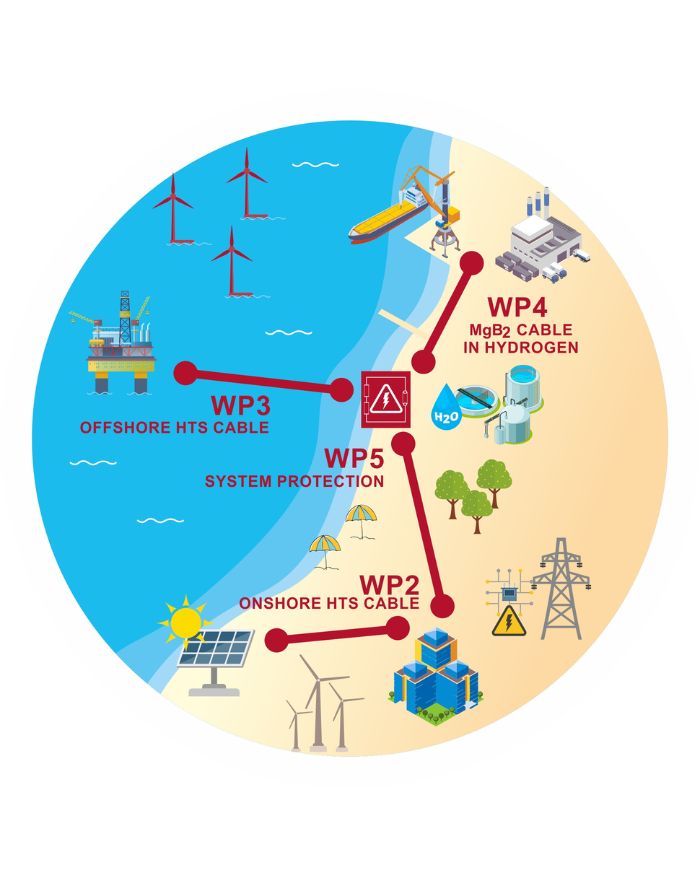
Onshore HTS cable (LN₂, 70 K)
Full-scale design, manufacture, type testing and demonstration of a High-Temperature Superconducting cable system rated at ±50 kV / 10 kA, equivalent to 1 GW per bipolar link.
Offshore HTS cable
Design of long-length offshore MVDC superconducting cable systems, including reinforced cryostats, joints, shrinkage management, and distributed offshore cooling substations.
MgB₂ cable in liquid hydrogen (20 K)
Development of MgB₂ superconducting cables cooled with liquid hydrogen, enabling simultaneous power and clean hydrogen transport, a new paradigm for renewable energy logistics.
Grid protection & system design
Design and testing of a high-current Resistive Superconducting Fault Current Limiter (RSFCL), alongside comprehensive electric system modelling, use-case analysis, and standardisation work.
Why conventional cable technology falls short
The energy transition is not just a generation challenge, it is a grid challenge. Transmitting ever-larger volumes of renewable power raises technical, economic, and spatial problems that conventional solutions are not equipped to solve.
- Infrastructure corridor saturation
Urban and coastal corridors are congested. Conventional HVAC and HVDC cables require large right-of-way corridors and significant land use, making grid reinforcement in dense areas increasingly difficult and costly. - The cost of offshore converter stations
High-Voltage DC cables for offshore wind export require large, expensive converter platforms offshore and on land. For remote or deep-water farms, this infrastructure alone can represent a decisive fraction of total project cost. - Transmission losses at scale
Conventional cables dissipate electrical energy as heat over long distances. As transmission distances grow and volumes increase, resistive losses become a measurable drag on system efficiency and carbon performance. - Scalability beyond demonstration
Superconducting technology has been demonstrated in pilot projects. The critical gap is industrial manufacturing at kilometre scale and multi-GW capacity, the step SCARLET is specifically designed to close. - Absence of standards and type tests
No established type test procedures exist for DC superconducting cables or LH₂ cryogenic systems. Without certified qualification pathways, commercial procurement and risk underwriting is effectively blocked. - Techno-economic uncertainty
Grid operators and project developers lack validated data to compare superconducting solutions against conventional alternatives at system level. SCARLET’s assessments are designed to fill this critical gap.
The numbers that define SCARLET’s ambition
3.2 GW
Power transmissible through a single 17 cm diameter HTS cable
Demonstrated in the Best Paths project; the technical baseline for SCARLET’s design targets
1 GW
Target power per bipolar link for both onshore HTS and MgB₂ cable systems
Equivalent to the output of a large offshore wind farm
±50 kV
Operating voltage for HTS MVDC cable systems, versus 320 kV+ for conventional HVDC
Enabling compact substations without offshore converters
10 kA
Current rating, enabling gigawatt capacity at medium voltage
Far exceeding what conventional XLPE cables can carry per conductor
~90 GW
Estimated total transmission capacity the consortium aims to unlock through commercialisation
Equivalent to tens of GW-scale offshore wind export corridors
30+ yrs
Nexans’ accumulated experience in HTS manufacturing, underpinning its leadership in the project
From LIPA (138 kV AC) to Best Paths (320 kV DC, 10 kA)
Engineering the core of Europe’s superconducting cable system
Nexans is not a peripheral contributor to SCARLET, it is one of its central technical pillars. As the only participant combining over three decades of HTS manufacturing experience with the industrial capacity to produce kilometre-length superconducting cables, Nexans was a natural lead for the project’s most technically demanding workstreams.
The company’s role spans the full cable system lifecycle: from the electromagnetic and thermal design of the HTS conductor, through cryogenic envelope engineering for both onshore and offshore environments, to type testing and the development of new accessories enabling distributed cooling along extended cable routes. Nexans also provides the cryogenic envelopes, the vacuum-insulated jacketing that maintains the cryogenic environment, for the MgB₂ cable developed by other consortium partners.
Beyond physical deliverables, Nexans is actively shaping the regulatory and standards landscape, submitting type test recommendations for DC superconducting cables and contributing to the certification framework for LH₂ cryogenic systems, without which commercial deployment would remain blocked.
Lead work packages
WP Lead — Onshore HTS
MVDC HTS Cable System Design at 50 kVDC / 10 kA
Nexans leads the complete design, modelling, manufacturing and testing of the onshore High-Temperature Superconducting cable system. This work package encompasses:
- Electromagnetic and thermal modelling of the HTS conductor stack
- Full-scale prototype manufacture at ±50 kV, 10 kA
- Type testing to qualify the system for commercial procurement
- Design of joints, terminations and accessories for kilometre-scale installation
- Development of distributed cooling accessories enabling long-route HTS systems.
WP Lead — Offshore HTS
Long-length Offshore HTS Cable System at 50 kVDC / 10 kA
Nexans leads the design of offshore HTS cable systems for wind farm export applications, addressing the unique challenges of marine environments:
- Core design adapted for long offshore lengths and dynamic loading
- Reinforced cryostat design and testing for offshore pressure and movement
- Joint and shrinkage management for thermal cycling at sea
- Cooling substation architecture for distributed offshore cooling networks
- Feasibility of eliminating offshore converter platforms vs conventional HVDC.
What Nexans will produce within SCARLET
Superconducting grids can facilitate the integration of large-scale renewable energy sources, such as offshore wind farms and remote solar power plants — and can facilitate the transition towards a low-carbon society whilst contributing to the development of a resilient future power grid.

Acceleration Units Director, Nexans
More about Nexans’ solution