Why copper’s supply gap now sets the sourcing standard
Circular economy
29 October 2026
5 min
copper cover

The copper market is balanced to slightly oversupplied today, and the supply gap is a medium- and long-term issue. S&P Global expects a deficit of 10 million metric tons by 2040, and Oliver Wyman expects a global copper shortage of 10% to 20% by 2030. For cable manufacturers and their customers, this changes what responsible copper sourcing means. Origin, traceability and environmental footprint now weigh as much as availability, and two levers secure supply over the long term: verified standards and recycling.

Nexans sets out its answer in a 2026 position paper on responsible copper sourcing. It rests on verified standards, recycling and partnerships across the value chain, and Nexans already applies it in its own operations.

Why is copper heading for a supply gap?

The market is not short today: the International Copper Study Group (ICSG) forecasts a refined copper surplus of about 104,000 tons in 2026. Electricity demand and the acceleration of the digital economy are pushing copper demand up. S&P Global sees demand rising about 50% to 42 million metric tons by 2040, while global production peaks at 33 million metric tons in 2030. The International Energy Agency (IEA) projects primary supply 25% short of requirements in 2035. Copper, once treated as a lowly commodity, now sits at the center of the energy and digital transitions, and recycled copper will have to help fill the gap that opens.

The cable and electrification industries feel this pressure first. Aluminum solutions can substitute for copper in certain contexts, yet electrification as a whole remains reliant on copper. A lasting deficit could therefore slow the pace of electrification itself.

What makes the copper supply gap structural?

Two factors make the imbalance structural and geological. First, new mines take a long time to develop, so production cannot adjust quickly to demand. S&P Global Market Intelligence reports an average of almost 18 years from discovery to production for mines started in 2020 to 2023. Second, the average grade of mined ore has fallen by about 40% since 1991, according to the IEA, from about 1% copper content to around 0.6% today.

Lower ore grades carry a direct environmental cost. To obtain the same amount of copper, more rock must be extracted and treated, which raises the footprint of every ton produced. Regulation is moving in parallel. The EU Corporate Sustainability Reporting Directive (CSRD) and the Critical Raw Materials Act raise expectations on traceability and impact, so the ESG quality of the metal is becoming as important as its availability.

18

years from discovery to first production of a copper mine.


Mines that started up between 2020 and 2023 took almost 18 years on average.


Source: S&P Global Market Intelligence

Urban mine: from used cable to new cable

Can recycled copper close the gap?

Recycling is one of the two main levers. With appropriate separation and refining processes, copper can be recycled repeatedly without any loss of performance. This “urban mine” approach also helps improve the environmental footprint of metal.

Refining capacity limits how much scrap can be recycled. To use this potential fully, countries need to expand their smelting and refining capacity. France, Italy and the United Kingdom, for example, are expected to hold a large surplus of scrap metal by 2030 relative to their current refining capacity.

Collection raises its own challenge. Large copper deposits lie dormant in decommissioned infrastructure, and recovering them takes high-performance reverse logistics that no single company can build alone. Nexans describes its approach to circular economy in more detail on its sustainability pages.
What does responsible copper sourcing mean in practice?

For Nexans, responsible copper sourcing combines two sources: primary (mined) copper and secondary (recycled) copper. The approach is built on the E3 model, which stands for Economy, Environment and Engagement and reflects the conviction that economic performance goes hand in hand with environmental and social progress. The model is part of the wider CSR strategy of the Group.

For primary copper, this means long-term partnerships with certified suppliers that apply recognized sustainability practices, including the OECD Due Diligence Guidance, the United Nations Global Compact and the standards of Veramark Assurance (formerly the Copper Mark). Nexans asks all partners to sign its CSR Charter and looks for credentials such as EcoVadis and Veramark Assurance, a global standard that covers 33 ESG criteria. Long-term contractual commitments and on-site audits help suppliers progress, including those at an early stage of their sustainability journey.

Standards also keep moving. Veramark Assurance reassesses its sites every three years, including the Nexans metallurgical facilities in Montreal, Canada and in Lens, France, so certification drives continuous improvement. Nexans received the label for responsible copper production in September 2023.

How does Nexans secure and decarbonize its copper supply?

The shift from a linear copper supply chain to a circular, transparent and certified ecosystem rests on three actions.

Transparency on primary copper

Responsible sourcing starts with visibility into where primary copper comes from. Supplier charters, audits and recognized labels such as EcoVadis and Veramark Assurance give suppliers and customers shared references. Primary supply includes a large contract with KGHM for copper cathodes.

recycled copper in Nexans production

Recycling as a strategic pillar

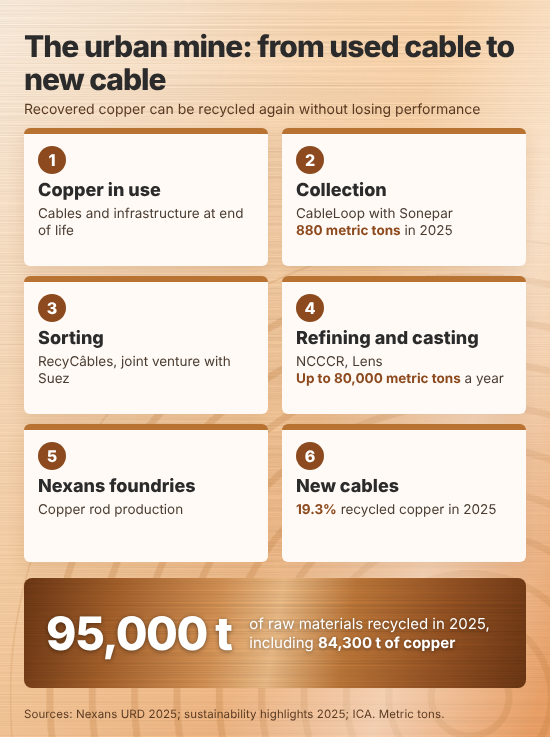
Recycling is central to the future supply chain. Nexans is investing €90 million in the Nexans Continuous Copper Casting and Refining (NCCCR) project, a new recycling plant in Lens, France. A partnership with Continuus-Properzi will allow the plant to process up to 80,000 tons of recycled copper a year. The investment agreement supports copper production and recycling capacity across Europe.

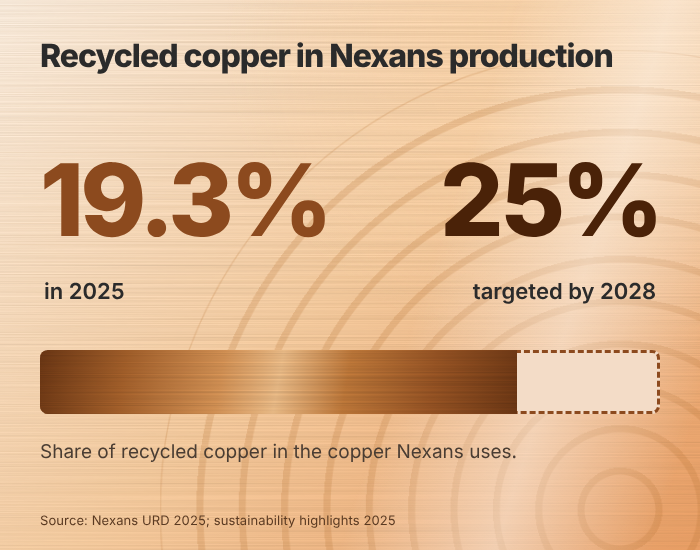
The recycled copper content of Nexans production reached 19.3% in 2025, which keeps the Group on track toward a 25% target by 2028. In 2025, Nexans recycled 95,000 metric tons of raw materials, including 84,300 metric tons of copper. In Europe, cable sorting and recovery runs through RecyCâbles, a joint venture created with Suez in 2008.

Collaboration across the value chain

The urban mine needs partners to reach scale. CableLoop is a recovery and recycling service launched in Europe with leading distributors of electrical products and solutions. Electricians and installers can drop off cable waste at local branches or request on-site collections, and Sonepar uses the service for its warehouse offcuts. Nexans recovered 880 tons in 2025 through this approach, and the material goes directly back into its foundries.

What does the industry need to do next?

The structural gap between copper supply and demand calls on the whole industry. Moving from a linear model to an integrated ecosystem approach is now necessary, and the position paper points to a new alliance between committed manufacturers, miners and distributors built on three commitments.

The first is to generalize third-party verified transparency, such as Veramark Assurance, so that ethical sourcing becomes a shared license to operate. The second is to recognize recycling as a key lever for mitigating copper scarcity and as a significant contributor to copper decarbonization. The third is to break down silos so that urban mines can be activated at scale. Circular projects such as NCCCR also help reduce carbon impact at competitive costs.

Circularity is the backbone of our future supply. We must transform a linear value chain into a circular ecosystem to secure copper for the long term.

David Grall

VP Sustainability & Corporate Transformation, Nexans

Nexans is ready to turn waste into a sovereign resource, and circularity will carry electrification forward.

Continue the conversation

Download the position paper on responsible copper sourcing for the full analysis, the sourcing strategy and the recommendations for the industry.

Secure copper supply matters most where continuity is critical, including data centers, critical buildings and distribution networks. Hear how circularity and verified standards strengthen supply chains in the replay of the supply chain resilience and circularity webinar.

Resonsible copper sourcing

Responsible copper sourcing

Download the position paper

Frequently asked questions about responsible copper sourcing